


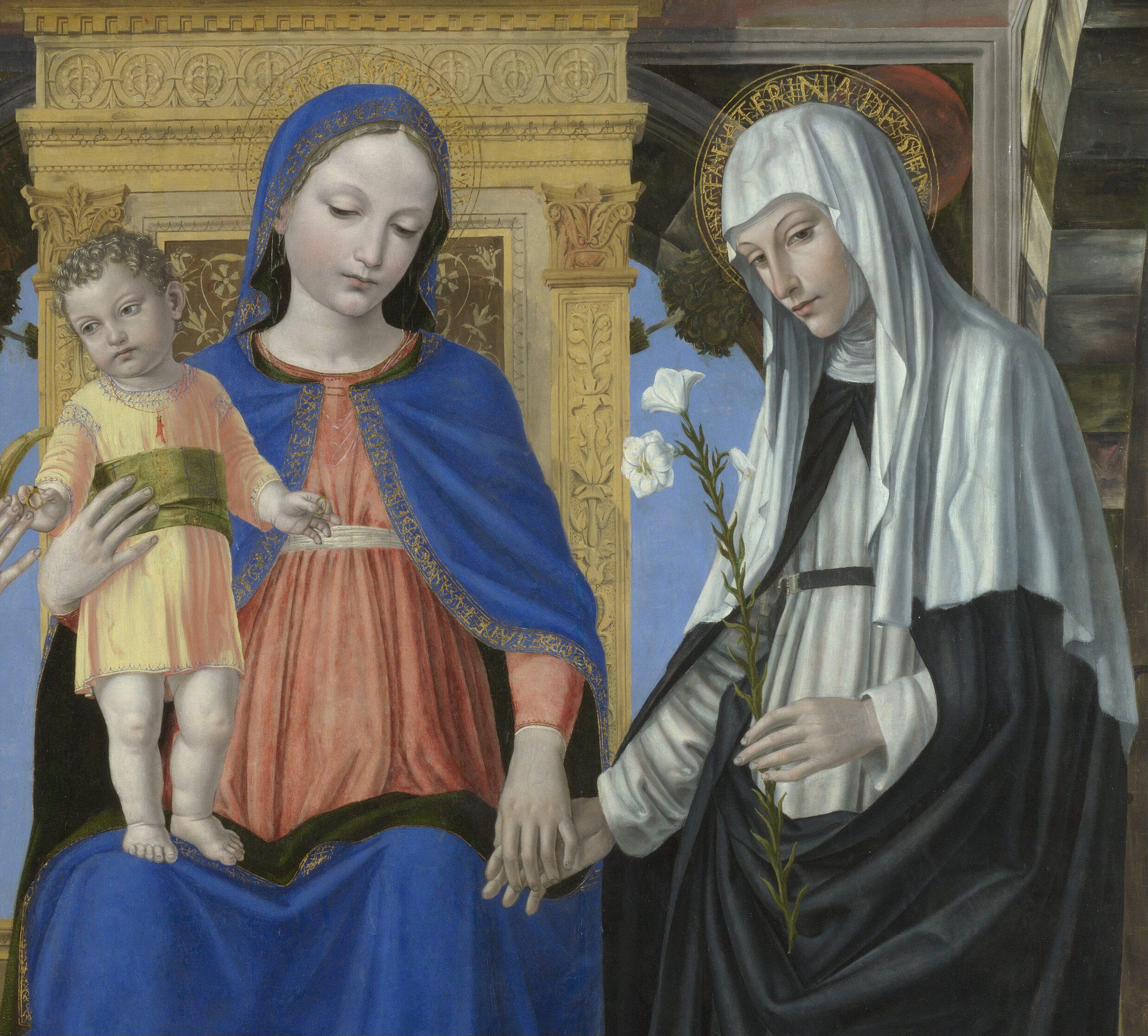
Caterina of Siena—more commonly known as Catherine, the English version of her name—was a bold Italian mystic of the 14th century who died in 1380, was canonized as a saint by Pope Pius II in 1461, and was named a Doctor of the Church by Pope Paul VI in 1970. For their protection and well-being, women in the medieval world were expected to either join a convent or marry, yet Caterina did neither. Realizing her call was to a spiritual life, yet also recognizing that her mission wasn’t to remain secluded but rather to teach God’s graces to others, Caterina did what no one of her young age (not quite 20) had yet to do—she joined the Mantellate.
The Mantellate were a Third Order of Dominican women who, although they wore a habit to distinguish their calling, were not nuns. This group of women, plentiful in the Tuscan region of Caterina’s birth, consisted of older ladies who lived in their own homes while maintaining a spiritual lifestyle of what I call the “Trinity of C’s”—charity, chastity, and community.
They vowed to give their all to God, meaning they served their community in whatever way they were able, such as charitable hospital work, ministering to the poor, and other deeds we’d now call “community service.” The chastity bit was a given—they were all older widows, and didn’t go gadding about with foolish young gentlemen. They were over that already.
However, there are two things we need to understand about the Mantellate in order to fully grasp Caterina’s out-of-the-box mission and why her lifestyle was constantly criticized (she was at risk for being condemned as a heretic on several occasions—and it was her own order, the Dominicans, who were in charge of the Inquisitional judgments).
First, although the Dominicans are known as the “Order of Preachers,” women didn’t liturgically preach—instead, their strengths rested in tending to the physical needs of others, providing emotional support, and even in private spiritual counsel. Even though, after three years of seclusion which allowed her to develop spiritual unity and strength, Caterina began her public life caring for the sick and poor, she soon realized her calling was much broader than the hospital walls of the Santa Maria della Scala in Siena, or even the walls of Siena itself.
Caterina was being called to do more, to teach and guide not only to her large group of close followers whom she began to call her spiritual famiglia, but also queens (such as Giovanna, Queen of Naples), vicious mercenaries (such as the Englishman, John Hawkwood), prostitutes and hermits, government officials, and even the pope himself (two, actually—Gregory XI and Urban VI).
Preaching and teaching was something women in the fourteenth century did not often do—yet Caterina did, and she did it well.
Another issue with the Mantellate was that this Third Order consisted of widows and elderly women only; no flighty young people were allowed. A young person hadn’t gained enough wisdom (or so the theory went) and besides, she would be too much of a beautiful temptation to men. Since the Mantellate weren’t cloistered, the risk of scandal should a young member be discovered snatching kisses behind the Duomo was too great.
As was her custom, Caterina broke all boundaries. Although she was a lovely young woman with a brilliant smile which many of her contemporaries couldn’t help but comment upon, she managed to convince the Mantellate superiors to accept her into their order. Through expressing her spiritual wisdom and firm theological knowledge—and also by conveniently contracting smallpox, which left her disfigured long enough to convince the Mantellate that she was too ugly to be a sexual threat—she was accepted into the Order at the ripe young age of eighteen (or thereabouts).
Becoming a Mantellate gave Caterina the protection she would have enjoyed if she’d married. It also allowed her a freedom she never could have had if she’d she entered a convent. It was the best of both worlds—at least for her calling.
As was her custom, Caterina ignored all social boundaries, much to the dismay of proper old ladies and certain stuffy church folk —and much to the delight of everyone else.
Even so, to become a spiritual director to many—including men—wasn’t something she was supposed to do, yet as was her habit she ignored human-made boundaries and continued to follow the will of God without question. As always happens when we devote ourselves to God’s will without reservation or question, things began to fall into place for Caterina, and her deeply-spiritual (yet also political) mission began to take on a God-willed life of its own. She even she helped convince Pope Gregory XI to return to Rome during a time when the papacy had been lounging in Avignon.
Because of her mission, which led her to spiritually teach both laymen and religious prelates, Caterina’s experience of spiritual direction was both vast and profound. Through it all, the core of her teaching rested on one principal—surrender to Divine Will. Caterina has been described as being as rich and profound as Tuscan wine, and certainly her contagious spirituality rested largely in the fact that she taught only what she herself practiced. Those teachings left her followers feeling intoxicated with Divine grace.
Early in her career, as she was still spiritually developing, Caterina had a vision in which God said to her, “Do you know who you are?” Silent, waiting, anticipating, Caterina then felt God continue, “You are she who is not. I am the One Who Is.”
I Am Who I Am (Exodus 3:14).
Caterina took this to heart. All we have, all we are, all we are given, are gifts from God. In ourselves we are nothing, we have no existence. Everything can be traced back to God’s blessings, and in order to take full advantage of a life of grace, we must fully surrender to Divine Will. From that point forward Caterina developed an astute ability to see God’s will in all things, a lesson she never forgot.

Special Offer!
If you’re intrigued by the life of St. Catherine of Siena and want to learn more, my adaptation of her early life (part one of a two book series) is currently on sale when you purchase directly from my website.
Learn more about World Between Worlds: A Novel Based on the Early Life of Caterina, the Mystic of Siena.
You can also purchase on Amazon using my affiliate link.


Just a phenomenal woman centuries ahead of her time, and yes, a lovely description of this great saint!!! Why she’s not better known is a mystery but not for long!!😉
I enjoyed this read and the way you described this saint :)