


The soul should not say her vocal prayers without joining them to mental prayer, that is to say that while she is reciting, she should endeavour to elevate her mind in My love.
(God the Father to St. Catherine of Siena, Dialogue 66)
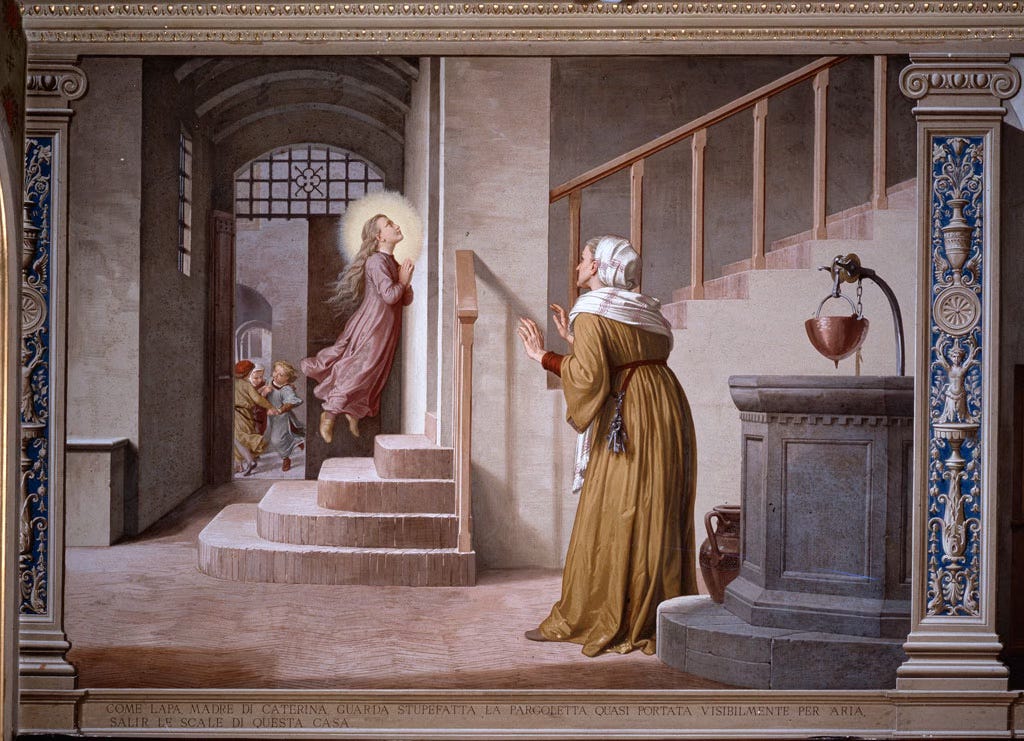
We have no direct record indicating that St. Catherine of Siena was familiar with the Rosary, but we can tell by her writings on prayer that she truly understood the essential interplay between vocal and mental prayer. Because of this, she has a great deal to teach us about the beautiful graces we can receive by praying the Rosary.
Caterina lived a century after St. Dominic is said to have popularized the Angelic Psalter, the devotion that developed into the Rosary. In the Middle Ages, the Hail Mary consisted of the angelic salutation coupled with St. Elizabeth’s greeting to Mary: Hail, full of grace, the Lord is with thee. Blessed are thou amongst women, and blessed is the fruit of thy womb. The last part of the Hail Mary as we now pray it wasn’t known in Caterina’s day—it was officially added two hundred years later, although it was informally introduced before the sixteenth century:
[The second half of the Hail Mary] was not introduced until the latter part of the Middle Ages. Since it seizes upon the two decisive moments of life: ‘now’ and ‘at the hour of our death,’ it suggests the spontaneous outcry of people in great calamity. The Black Death, which ravaged all Europe and wiped out one-third of its population, prompted the faithful to cry out to the Mother of Our Lord to protect them at a time when the present moment and death were almost one.
(Bishop Fulton Sheen, The World’s First Love)
When Caterina was born in the fourteenth century, the Angelic Psalter (also called the Marian Psalter) wasn’t yet widespread. Even so, Caterina held a fervent devotion to the Blessed Mother, walking with her often in visions and ecstasies, enjoying her mystical presence. In one vision Mary gave Caterina the infant Child to cuddle to her breast, while in another our Lady presented her Son to Caterina as Divine Bridegroom.
Even though Caterina may not have been familiar with the Rosary, we can find traces of the devotion within many of her writings. Sparkling examples of how Caterina prayed—and taught others to pray—can be found in a variety of her letters as well as her book, the Dialogue. She emphasizes that mental prayer is superior over vocal prayer, but that the two season each other to produce rich spiritual fruits. God the Father reveals:
But if you should ask Me whether one should abandon vocal prayer, since it seems not everyone is drawn to mental prayer, the answer is no. A person has to walk step by step. I know well that, because the soul is imperfect before she is perfect, her prayer is imperfect as well. She should certainly, while she is imperfect, stay with vocal prayer so as not to fall into laziness, but she should not omit mental prayer. In other words, while she says the words she should make an effort to concentrate on My love, pondering at the same time her own sins and the Blood of my only-begotten Son.
(Dialogue 66)
The Rosary isn’t about reciting a series of rote prayers with a goal of saying the words simply to get through the entire string of beads. Rather, the true power of the Rosary rests in the mental prayer beneath the vocal—the meditations on the Mysteries of our Lord’s life so we can concentrate on His love, pondering the balance of our sin and the infinite divine mercy He holds within His sacred heart.
Vocal Prayer—“Saying orally the Divine Office or some other prayer one might wish to say” such as the Our Father, Glory Be or Hail Mary. “The purpose of this sort of prayer is to lead into mental prayer” (St. Catherine of Siena, Letter T154).
Mental Prayer—Speaking directly and intimately to God. “Mental prayer in my opinion is nothing else than an intimate sharing between friends; it means taking time frequently to be alone with Him who we know loves us” (St. Teresa of Avila, The Book of Her Life).
Caterina goes even further. Through her close union with God she receives the wisdom to understand the true secret to prayer. Although vocal prayers, such as the Our Father, Glory Be and Hail Mary, are essential stepping stones, when God seeks to speak to us in mental prayer we must stop our vocal prayer and listen to His words of loving grace.
Vocal prayer … is saying the Office or other prayer with the tongue. Its purpose is to bring us to mental prayer. We arrive at this when we wisely and humbly exercise our mind in vocal prayer. That is, when we speak with our tongue, our heart is not far from God. But we have to make an effort to establish and stabilize our heart in the affection of divine charity. And when we sense that our spirit is being visited by God—that is, when we are in some way drawn to think of our Creator—we should abandon vocal prayer and set our mind with love’s affection on what we sense as God’s visitation.
(Letter T353)
We shouldn’t pray the Rosary just to get through it, to say we recited five (or fifteen) decades and now our “duty” is done. Being fixated on the number of vocal prayers we recite can actually be a trap of the evil one, who is intent on preventing us from drawing closer to God. The Father reveals to Caterina:
If [the soul] looks only to the completion of her tally of prayers, or if she abandons mental prayer for vocal, she will never advance. A soul may set herself to say a certain number of oral prayers. But I may visit her spirit in one way or another, sometimes with a flash of self-knowledge or contrition for her sinfulness, sometimes in the greatness of my love setting before her mind the presence of My Truth in different ways, depending on My pleasure or her longings. And sometimes the soul will be so foolish as to abandon My visitation which she senses within her spirit, in order to complete her tally …
This is not the way she should act. If she did, she would be a dupe of the devil. No. As soon as she senses her spirit ready for my visitation, she ought to abandon vocal prayer. Then, after the mental prayer, if she has time, she can resume what she had set herself to say. If she does not have time she ought not worry or be annoyed or confounded in spirit …
Such prayer, made in the way I have told you, will bring her to perfection. This is why she should not abandon vocal prayer, whatever its form, but should advance step by step. Thus, with practice and perseverance she will experience prayer in truth.
(Dialogue 66)
The one exception is the Divine Office for those in a religious vocation. “Clerics and religious are obliged to say it, and sin if they do not say it.”
God reminds us all through St. Caterina that perfect prayer is achieved not with many words but with loving desire … In this way she will have vocal and mental prayer at the same time, for the two stand together like the active life and the contemplative life … courageously, then, should the soul spur herself on with prayer as her mother.
Perfect prayer consists in loving God, resting in His Truth, and allowing the Holy Ghost to infuse us with the grace of His presence. The prayers of the Holy Rosary act as a bridge between vocal prayer to mental prayer; from the sacred words of vocal prayer we can achieve higher levels of mental prayer, thereby enjoying true intimacy with our Lord.
If God graces us with His presence and we’re drawn into an intimate communion with Him—whether that be in conversation, thought, or remorse for sin—we shouldn’t cling to a certain number of repetitions of vocal prayer. Learning when to stop vocal prayer and allowing ourselves to sink into mental prayer will help us rise above everything within ourselves that is not of God so we may become “united with God in affectional love. In the light of understanding we see and know the truth and are clothed in it” (Letter T26). We become as a fish in the sea. “For then the soul is in God and God in the soul, just as the fish is in the sea and the sea in the fish” (Dialogue 2).
Special Offer!
If you’re intrigued by the life of St. Catherine of Siena and want to learn more, my novel about her early life (part one of a two book series) is on sale when you purchase directly from my website.
Learn more about World Between Worlds: A Novel Based on the Early Life of Caterina, the Mystic of Siena.
You can also purchase on Amazon using my affiliate link.


Thank you for this excellent post. I am reminded of the words of Pope Adrian VI: “The Rosary is the scourge of the Devil.”
Its funny that she may not have been familiar with at least the modern form of the Rosary, given her depiction in Icons of Our Lady of the Rosary (or of Pompeii.)